Showing posts with label South Dakota. Show all posts

Thursday, September 08, 2011

Mammoth Site of Hot Springs

Friday, August 26th - - Continuing south from Wind Cave National Park, I stopped in Hot Springs, South Dakota to take a look at the Mammoth Site located there.


Some 26,000 years ago a sink hole developed trapping unsuspecting Columbian and Wooly Mammoths as well as other animals. Once in the sink hole, the animals could not escape and their remains are slowly being uncovered, a fraction of an inch at a time, by archeologists. A building was constructed over the area of the sink hole to provide a good working space as well as a means of protecting the fragile bones.


Looking down into the pit you can see numerous tusks and other bones of the Mammoths. Several almost complete skeletons were found but mostly the various bones are scattered here and there throughout the site.


Here you can see the rear legs and the rib cage of a Columbian Mammoth that was desperately trying to escape from the sink hole. Alongside him (or her) are the tusks of another trapped Mammoth.


I forget how far down they have excavated, perhaps a hundred feet or so, and they have uncovered the partial remains of 58 Mammoths. The sink hole is several hundred feet deep and they expect to find many more animals that were trapped.


After touring the main excavation site there is an impressive display in the exhibit hall. Prior to the tour, a video is shown that explains how the sink hole developed and how the animals were trapped within. It was well worth the slight detour south to visit the site.

Wednesday, September 07, 2011

Custer State Park :: Nature's Bounty

Friday, August 26th - - I took my time driving through the park as I was leaving, making a big loop north and another one toward the south.


The Cathedral Spires are in the northwest side of the park, along Needles Highway, and were magnificent in the early morning light.


The Iron Mountain Road takes you along the north east side of the park and was considered an engineering marvel when it was first built. It is still rather impressive with the sharp curves, hairpin turns, wooden bridges, and tunnels that were bored through the granite rock – the three tunnels on this route perfectly frame the Presidents on Mount Rushmore that are seen in the distance. I took no pictures on that route – there was too much traffic and the parking areas near the tunnels were filled to capacity when I passed by that way yesterday.


I only drove a short portion of the Wildlife Loop Road as I was leaving the park - it went back north and I was headed south. Buffalo were grazing in the meadow when I turned onto the road.


A hungry calf.


Upon exiting the road on my return, the Bison were taking a break in the meadow. The park maintains a herd of about 1,300 bison, of which these were but a small part.


These antelope were seen a little ways south of Custer State Park but before getting to Wind Cave National Park. I stopped at Wind Cave visitor center but did not take a tour into the cave – too many steps down and I've toured several other large caves.


Tuesday, September 06, 2011

Mount Rushmore – And a New Camera!

Thursday, August 25th - - You can't go to the Badlands and Rapid City and not stop to see Mount Rushmore, can you? I had been there with my mother back in 1976. We happened to get there on the Fourth of July and since our country was in the midst of its Bicentennial year, there was a big celebration going on with fireworks and everything. It was awesome. From that visit I knew there were some places along the highway that The Presidents could be seen, besides I refused to pay $10 for parking! Call me cheap if you will....

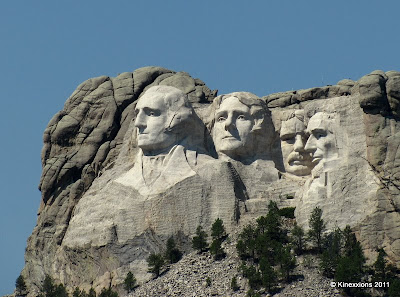


I had decided to spend another night at Custer State Park and went into Rapid City to take care of some business - I needed a new camera! The one I had was putting a rather large grayish spot in the upper center of some pictures. Not all of them, usually those with a pretty blue sky. If you noticed, many of the shots taken in the Badlands and within the past few weeks were cropped to cut out some of the sky – that's why. Camera going bad. Not good. It also makes a bit of a grinding noise when the lens is extended when turning the camera on. Probably dirt or dust in the mechanism.

I had been looking around for the last couple of weeks but there wasn't a “big box” electronics store in the small towns I'd been through. Wally World had several nice cameras (Canon SX30 IS and a Nikon) on display but they were out of stock everywhere I stopped, including Rapid City. I ended up getting what was in stock and what met most of my criteria:
  • A viewfinder (a must under bright light conditions as I often found that I couldn't see what I was taking a picture of!)
  • Uses AA batteries (I severely dislike brands that use proprietary batteries and I love the convenience of “regular” batteries, especially rechargeable ones).
  • More megapixels and greater zoom capabilities than the current camera.
What it didn't have that I wanted was a position-able or adjustable viewing screen (the kind you can flip up or down). But I can live without that.

I played with the idea of getting a digital SLR but I really like the convenience of a smaller camera. I hauled around bunches of lenses and camera bodies when in the Navy and for years afterward. Just didn't want to do that again.

I purchased a Fujifilm Finepix S2940 with 14 megapixels and an 18x zoom. The current camera was 12 megapixels and 12x zoom. Also would have liked a little bit more zoom capability but the 18x zoom is a nice compromise. It is about the maximum that I can effectively hand-hold and not get fuzzy photos! Anything longer would require use of a tripod, at least for me.

The first three photos were taken with the “old” camera (Canon SX120 IS) in the morning and the last three with the new Fujifilm camera in the afternoon. The image of Washington was cropped from a landscape photo only so much as to eliminate traces of the other fellows. The Lincoln image is not cropped at all.

There seems to be a bit of a “lag time” before the next picture can be taken, but overall I'm happy with the new camera and I'm loving the viewfinder! It also has a panorama setting that is pretty slick.

=+==+==+==+==+==+==+==+=

Update: After using it for five days, the Fujifilm camera went back to the store. The "lag time" between photos was unacceptable. It would take anywhere for 10 to 30 seconds between shooting one picture and being able to take the next one! If I'd had this camera in White River, I never would have been able to take those action photos of the rodeo. It didn't seem to matter whether the batteries were fully charged or partially used or nearly completely used. I really liked the camera but that "feature" made it difficult for me to continue to use it. The other thing that I didn't like was that it did not have an on/off button, rather it had a sliding switch that sometimes didn't turn the camera on when it was moved to the "on" position. I would NOT recommend this camera to anyone! So, I've reverted to using the "old" camera again for a while, until I can find what I want. I'm looking at the Canon SX30 IS and the Nikon P500. Although several "big box" stores have them on display they don't have them in stock, at least in the places I've stopped! Sigh....

Monday, September 05, 2011

Custer State Park :: Bighorn Sheep

Wednesday, August 24th - - After spending not quite five hours in Badlands National Park, and with temperatures into the 90s, I was hot and tired. Route 44 took me toward Rapid City but my destination for the night was a little to the south, Custer State Park.

As it turned out, all campsites in that park are by reservation only. However, you can call in when you get there to make a reservation. As a non-resident of South Dakota, I also had the privilege of paying an extra fee to make that reservation! In addition to that fee, the park charges $15 for an entrance pass, which is good for seven days. Most other South Dakota parks also have an entrance fee but much smaller and good for just one day. Custer Park “did away” with the daily pass last year.

Anyway, I was assigned a site at the Center Lake (I think it was) campground. It's a large park and I don't remember how many campgrounds there are, perhaps half a dozen or so. It was about four o'clock in the afternoon and I was driving on a hilly, curvy road to the campground, which was about ten miles from the entrance, when I came upon two cars stopped in the road. I could see several bighorn sheep right alongside the road and rather impatiently wished that the drivers ahead would move on so I could get close enough for a picture.

After a few minutes they did move on and I slowly drove up next to the sheep and stopped, having already put the passenger window down. I was able to get off one shot when several motorcycles came from the opposite direction and another shot as the bighorn sheep scrambled down the side of the hill and into the woods.


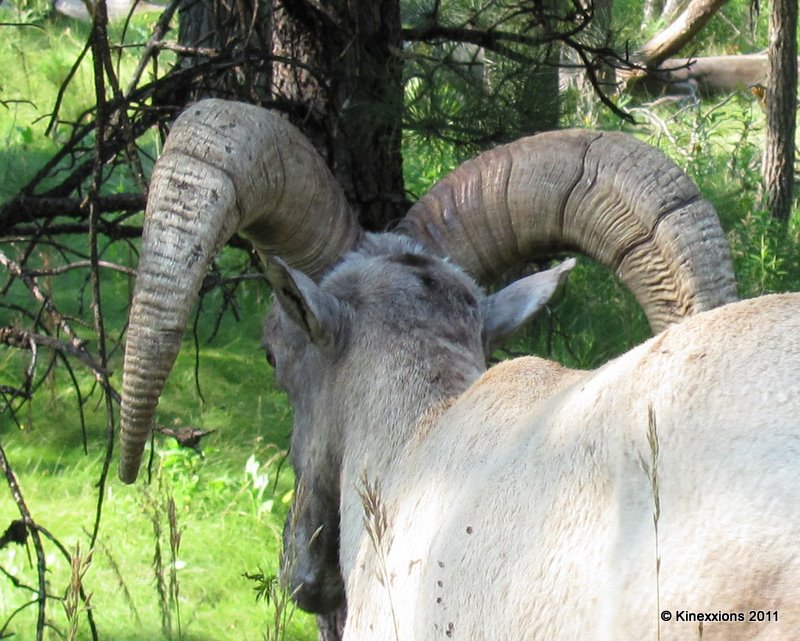
When I took this photo, I was a little disappointed that the sheep had turned away. However, I think it really shows the size of those horns rather nicely!


A cropped version of the above photo.

All in all, it was a rather incredible day! I'd like to return to the Badlands some time when it isn't quite so hot and take a few of the trails that I missed this time.

Badlands :: An Incredible Landscape

Wednesday, August 24th - - Badlands National Park is comprised of the North and South Units consisting of 244,000 acres. The South Unit was added in 1976 and is managed by the Oglala Lakota Nation. It contains many sites sacred to the Oglala Lakota people as well as a great quantity of unexploded ordnance – the area was used as an aerial bombing range during the Second World War. The South Unit is largely undeveloped with few roads or trails; it is primarily a protected natural area.

The North Unit, sandwiched between Highway 44 and Interstate 90, is the one that the vast majority of visitors see, myself included. The main route through this section is the Loop Road.


I entered the Park on the northwest end, from Wall on route 240. After exploring the Sage Creek area (where I was engulfed by a herd of bison) I returned to the Loop Road and continued eastward.


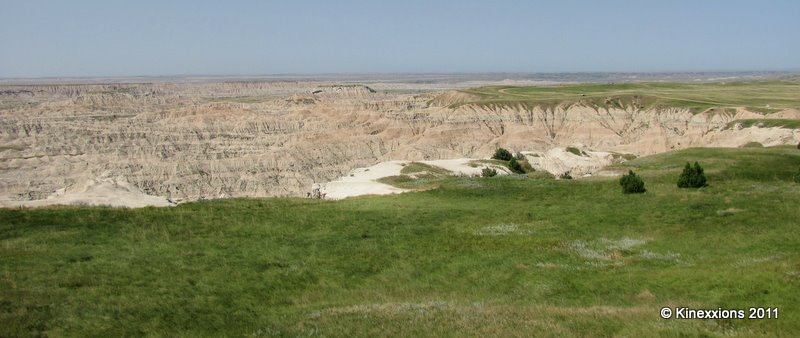
The Pinnacles Overlook area.


The Ancient Hunters Overlook. This is where evidence has been found that the Ancient Ones stampeded herds of bison over the edge of the cliff and butchered the fallen animals.


Yellow Mounds Overlook.

The yellow and red layers in the formations are fossilized soils, called paleosols. Fossil root traces, burrows, and animal bones found within the soils provide scientists with evidence of environmental and climatic changes that occurred in the badlands over time.


Driving through the Conata Basin.


The Conata Basin. See the car on the road in the lower left corner?


Homestead Overlook.

According to a sign posted at the overlook:
Homesteaders poured into the Badlands when the Milwaukee Railroad completed track through the White River Valley in 1907. Most of the homesteads turned out to be “Starvation Claims” and were abandoned or sold. Starved-out homesteaders moved on to build towns and cities, or to seek another homestead in a land less harsh. Today the ranches of this valley are measured in thousands of acres, and heavy equipment does most of the work once done by callused hands. Even so, unpredictable drought and economic crisis test ranchers today as severely as they tested homesteaders yesterday.

Fossil Trail.


Exiting the park through Cedar Pass.

Sunday, September 04, 2011

Badlands :: Rolling in the Dust

Wednesday, August 24th - - The gravel road continued on for a few miles but I turned around and headed back to the main road. As I passed Sage Creek Basin Overlook the bison that had surrounded me a few minutes earlier had made their way off into the prairie. To my right another small band of buffalo were coming across the road. Traffic was stopped until long after they had passed.

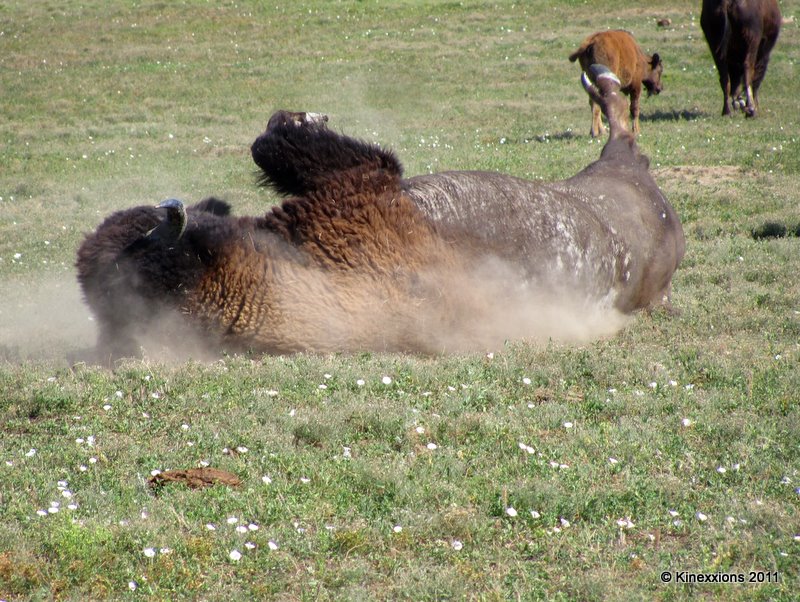
Prairie Dogs provide a service to the buffalo by giving them a place to roll in the dirt! At the entrance to the burrows there is always a large pile of dirt that has been thrown up by the Prairie Dogs digging the tunnels. Hopefully, when a bison decides to roll in that dirt, the little fellows have made it safely underground!


Going down....


Really getting into it!


Ah, that felt good.


Giving it another go.


Shaking off the dust.


Feeling better, I'm sure!

Badlands :: A Prairie Dog Town

Wednesday, August 24th - - After the bison had moved along, so too did I. Traveling a short distance on the gravel road, I stopped at the Prairie Dog Town and watched the little critters for a while. Some were rather close to the road but as soon as I opened the door and stood up they all scurried off to their burrows. So I got back inside Van Dora and waited a few minutes until they decided to come back out. All of these photos are cropped, some more so than others.


Youngsters. Not sure they should go down into the safety of their burrow or stay outside. A second later and they had disappeared.


Oftentimes you see more with the camera (thank you, whomever invented the zoom lens!) than you do with the naked eye. This little fellow, and the ones below, were quite a distance from a burrow and fairly close to the road, sampling the morsels provided by Mother Nature.


It was so much fun watching these little guys. They were quick to scurry off in every direction at the lightest noise – a cough, a clearing of the throat, even sometimes the sounds of the camera.

Saturday, September 03, 2011

Badlands :: Where the Buffalo Do Roam

Wednesday, August 24th - - As I pulled in the Sage Creek Basin Overlook, I remembered from the sign at Hay Butte that bison reportedly roam this area but I hadn't noticed any. I drove on over to the far side of the parking area and was getting out of Van Dora when I heard a grunting, snorting sound behind me.


Turning around I saw a long line of buffalo, the first few were approaching the top of the bluff and were just a few feet away! They extended for quite a distance down the hill. I immediately got back into the van and put the windows down so I could take pictures.


The vast majority of the buffalo came up on the passenger side of the van but the one above and below came up on the drivers side, and oh, so close!


I think this one must have been the calf of the one above. They stuck pretty close to each other the entire time I saw them.


I thought this was the last of them...


So after they passed by, I gathered some nerve and stood up outside the van and saw more of them coming.


Others that had already come up moved slowly through the parking lot, some continuing on across the road. But some of them stopped to browse or scratch their bellies on the posts that delineated the parking lot.


They were of all different ages and sizes and colors. Just like people, bison have distinguishing characteristics too.


For about 15 minutes I was entirely alone with this herd of bison. It was incredible. The sounds they made were like nothing I had ever heard before – growling, grunting, snorting. This car was stopped in the road waiting for the buffalo to pass – it took about 30 minutes from the time I first saw them for all of them to get to the top of the bluff and across the highway. This one lone bison lingered for quite some time scratching his belly on the post then he (or she) too moved on. And all I could do was shake my head and say Wow! again and again.